Travails of soccer, ministry, and vuvuzelas...

Tuesday, October 28, 2014

Heaven!

Today was another busy day.  We traveled by van 2 and a half hours south to one of the Universities to meet 17 students who go to school there studying things like Electrical Engineering, Computer Science, Pharmacy, Bioteach, etc.  We arrived to find a couple of guys cutting the grass by machete!

We took a brief tour of the campus and then went to lunch.  We tried one place, but they did not have enough food for our group and we ended up going to another buffet.
It was great getting to talk to the students.  I sat next to Collins, studying Biotech, who is an exceptional student and a really cool guy.  The Rwandans tend to be a shy and reserved group and he is one of the few that will speak up and actively pursue leadership roles.  He is one of the two student representatives for the students and wants to get his Masters at the University of Western Cape in Capetown which is the finest University in Africa.  He asked me some questions regarding my presentation on Saturday and is one of several students that asked me to email the PoPowerPoint We got in a great conversation regarding jobs and internships and the working world.  This guy has an amazing future!  Collins and Jean Darke picutred on the left.

I happened to bring a Kindle with me and Justin wanted to film a video with Jean Darke (the girl who got an Internship working on the Kindle).  She had no idea what is was and he got some good video of her playing with it.  He also got a video of students with coke bottles in an effort to gain some support from the Coca Cola Foundation.  Justin is really great at taking pictures and videos with the students to thank individuals who have supported them and to promote what These Numbers is doing.

After lunch, we bid farewell to most of these students as we will not be seeing them again.  We headed to the market with Collins and another student Jackie who had traveled with us.  I got some great Rwandan goods including a Peace basket; the peace basket is made together by someone who committed violence along with a victim to promote reconciliation.  The one that I got represented friendship and had a few smaller ones inside of it.  We then headed to this cool ice cream shop where the slogan was "ice cream, coffee, and dreams".

We traveled the long trek back to Kigali and went straight to this really nice restaurant called "Heaven" which has really amazing food.  I have eaten so well this week!  This restaurant also has a really cool story as it was started by an American husband and wife who came to Rwanda to promote healthcare and peace.  The wife also had a foodie background so they created this really nice restaurant that mostly foreigners eat at because of the price.  However, the staff is University students that they help support and who they train how to work at a fine restaurant.  Service is generally not very good in Rwanda and we have had our orders messed up several times, but the service is excellent her and they are doing a cool thing with these students.  They also sell Rwandan art.  Rwandans are funny as they don't like to try any new food at all.  This is especially true of a staff person, Jackie, who doesn't like Mzunga (white person) food and that is all this restaurant has.  She ended up ordering a bowl of ice cream for her dinner!

Monday, October 27, 2014

Hope

Today we traveled an hour west of Kigali to a Congolese refugee camp and it was another powerful day.  A little history here.  When the current President Paul Kagame overran the Hutu in 1994, around a million Hutu fled to the neighboring Congo where they feared retaliation (that never came).  Congo is also made up of Tutsis and Hutu and the Hutu went into the Congo and continued to kill Tutsis.  The Congo was already a pretty unstable place because of the mineral wealth and this made things even worse so many Tutsis fled to Rwanda to live in refugee camps where they are allowed to stay but don't receive much help from the government.  These camps which were met to be temporary have been around for nearly 20 years.  The people live on 24 cents a day sent to them on cell phones by the UN.  They have now built houses out of mud in very rocky terrain and use the UN tents as roofs.  The camp we visited has 14,000 refugees.

These Numbers has several Congolese students who have defied the odds and can enter University through their program.  Two of these students scored among the top 30 in the country (one number 2!) and would have been eligible for a government scholarship to go to select Colleges in the U.S., but they were denied because they were Congolese.  One of these, Jean Paul, has actually been resettled with his family to the U.S. in Portland where he has started attending College.

There is an Adventist group that provides education in the camp through what would be our equivalent of 10th grade.  However, to attend University you must sit for your A Levels which would be the equivalent of our last two years of high school and you must score high enough on the placement test.  Some of the extremely bright students can win scholarships to schools in nearby communities.  However most of the students have no opportunity to pursue college.  Amazingly enough, they decided to start their own A Levels school called Hope school in 2009.  They started with 40 kids a year and are now up to 290!  They found volunteer teachers from their community to teach them.  Alice, pictured here, is in University with These Numbers, turned down a paying job to come back and voluntarily teach.  She is studying Electrical Engineering and teaches math and science at the school.  The guys pictured next to her run the school.  It is such an amazing and inspiring story!

Keep in mind that this community has no electricity or running water and large families live in very cramped houses.  I am inspired by how hard these kids work and how maintain hope in such tough circumstances.  The dream of the community is to be able to return to Congo some day.  The University students hope to take the skills they learn to bring things like electricity, roads, water, and other services when they return to Congo.  Unfortunately, the situation in Congo is still not very good.

We visited the three students houses and met their families.  Kalami's family cooked us a spectacular feast that was incredibly delicious.  We had a very large family cramped into the house, but had an amazing time with them and we even shared with them about snow.
Claude's story is so incredibly remarkable.  He is the youngest of 5 children of his mother and father.  His mother died and his father went back to the Congo to start a family with a new wife.  Both he and his new wife died.  The 5 siblings made an incredibly dangerous trip to the Congo to retrieve their 7 half brothers and sisters to bring them back simply because they were their siblings.  The oldest child became the head of the household and had to care for 12 kids.  They are truly a remarkable family and the whole experience truly moved me.  I finished the day by having a great conversation with Tina about the history of Rwanda and the future of These Numbers.  I am in awe of truly amazing things that are being done here.

Sunday, October 26, 2014

Surprising a Rwandan with the Internship of a lifetime

Following the museum, we traveled to a student's house in a poor neighborhood without running water.  We were quite a hit for all of the kids in the neighborhood.  We met her mother and sisters and came with a very big surprise.  She is a very bright Computer Engineering student who we were surprising with an Internship in San Jose, California with Amazon Lab 126 to work on the Amazon Kindle.  Going to America has been a dream of hers and it was very emotional for both her and her mother.  It was also quite the emotional swing for us after coming from the genocide museum.  Her mother celebrated with us and served us all biscuits (cookies), tea, and juice.  It was such a cool moment to be a part of.  Photos below.  I have an amazing video but it is too long to upload here.


A pretty intense visit to the genocide museum

What a crazy emotional day today was.

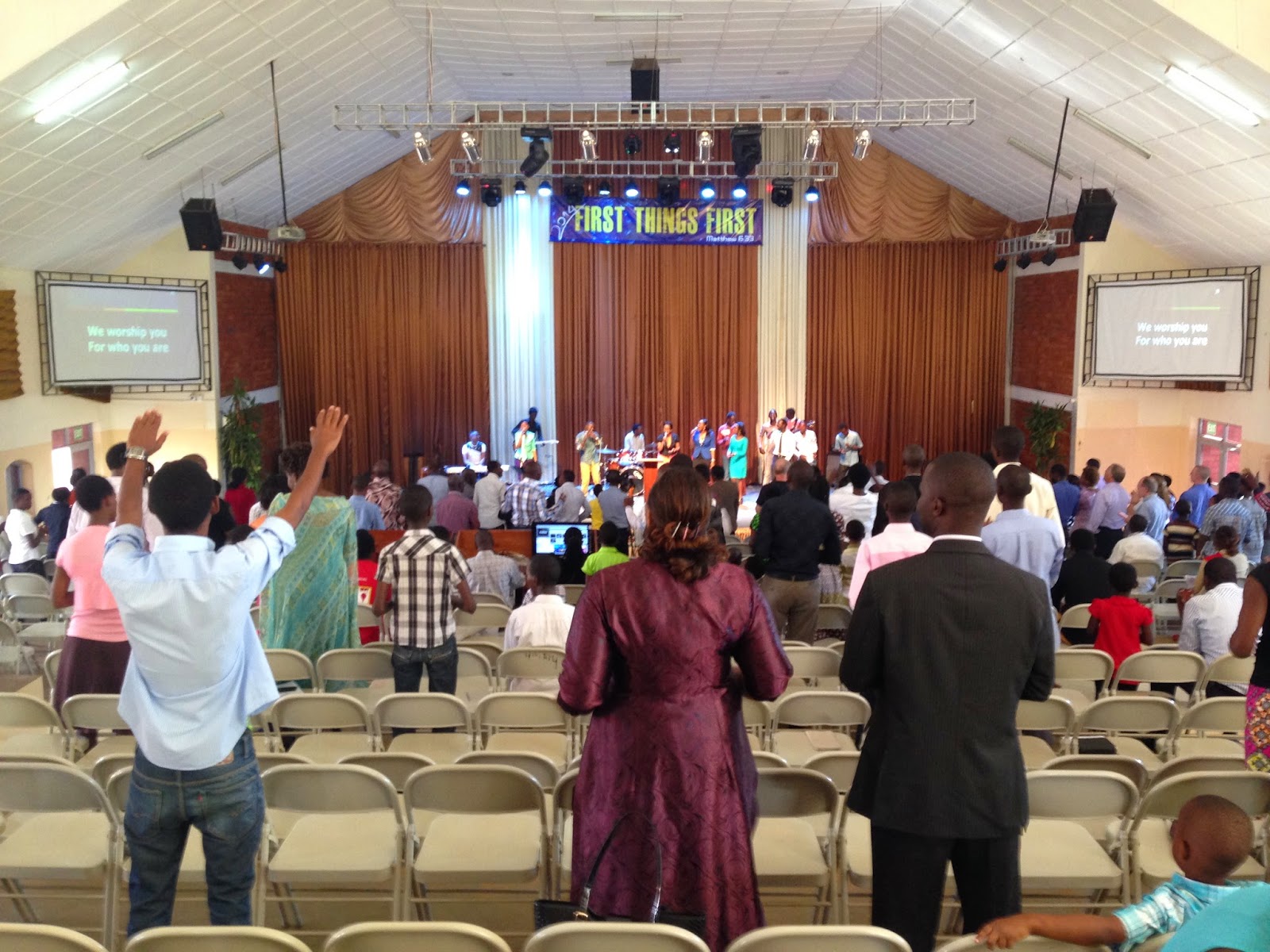
We went off to a Rwandan church which consisted of some lively reggae style worship and probably an hour sermon.  It was an english language service so were able to follow the service pretty well.  He preached on a passage in 1 Chronicles about Jebez asking for more territorty that I have never heard preached on.  All in all it was a pretty good sermon about overcoming challenges when listening to God, about trusting that God will give you what you need when you are out of your comfort zone, and about how God can work in different ways than we anticipate.

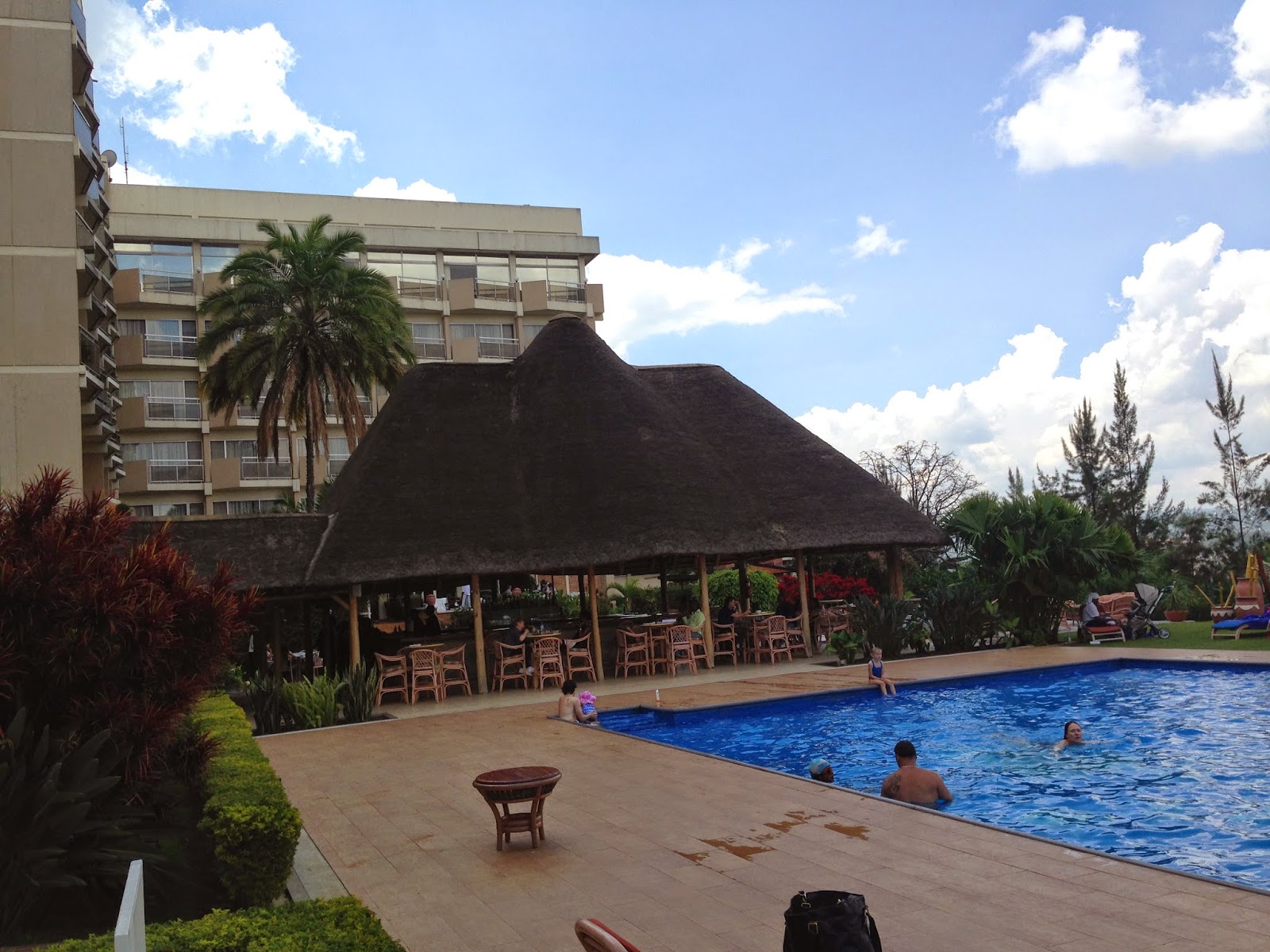
After the service, we headed to the Hotel Des Mille Collines for lunch that is the hotel where Hotel Rwanda took place.  It was pretty crazy to be in the actual place.  It is one of the two nicest hotels in Rwanda and we had quite the buffet feast.  It was hard to imagine what it might have been like and the hotel doesn't really acknowledge what took place there and a lot of Rwandans believe the guy featured in the movie to be a liar.

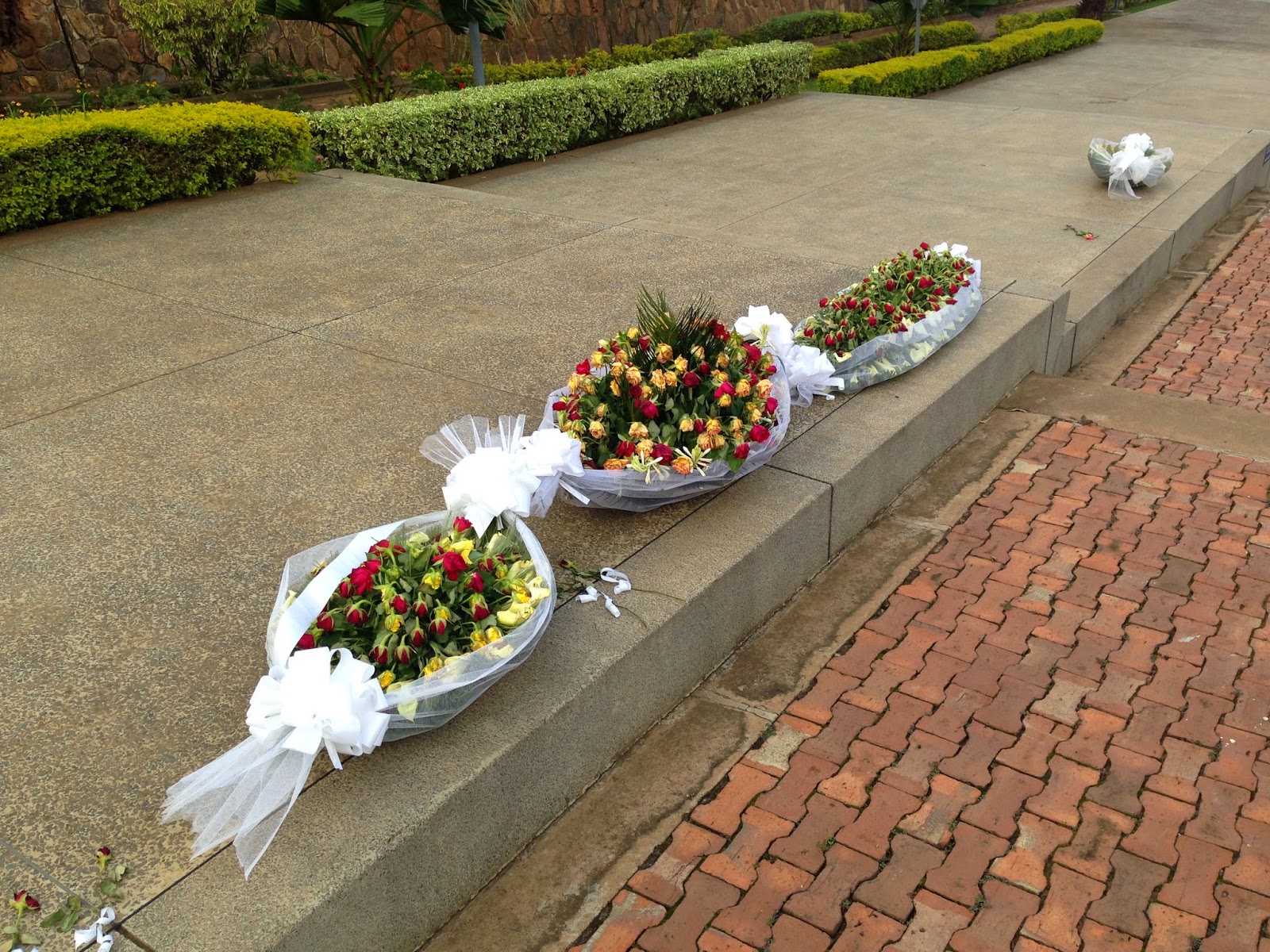
We then headed for a very emotional trip to a genocide memorial museum.  We took the two student leaders, Collins and Jessica, with us.  The genocide was largely Tutsis being slaughtered by Hotus.  Many of the students in TNHF come from Tutsi families that had fled to countries like Uganda, The Congo, Burundi, and Kenya prior to the genocide in 1994.  They were born in those countries and the families returned to Rwanda a few years later with a Tutsi leader who ended the genocide when his military forces came in from Uganda.  Still most of the students have had family that were killed in the genocide, but Collins was very forthright with us about the conflict.

The genocide museum was at times very hard and emotional to walk through.  We learned some of the history leading up to it with the German and Belgian colonization and the Belgians dividing the people into two groups before giving way to Independence in 1959.  The Hotus came to power and there was killing in 1962 and along the way leading up to 1994 when the Hotu leader's plane was shot down setting off the massive genocide where somewhere between 800,000 and 1,000,000 people were slaughtered in 3 months.  Most of this killing was done at the hands of machetes or clubs and at times the museum was very graphic with the images of bodies piled upon bodies.  Friends and neighbors would kill each other and families would turn on each other.  It was utterly horrific.

There was a section dedicated to children who were slaughtered and horrible things were done to babies and very young children (a 4 year old stabbed in the head in the eyes) and others bludgeoned to death or burned to death or torn up with a machete.  Following that, we entered rooms that actual skulls from people who died (some with large holes in them) and also containers with bones piled on bones.  It was very hard to look at and it just boggles my mind how people can do those types of things to others.  We finished by walking around several actual mass graves including an open one.  IT was all a very intense experience.

The coolest running group!

Because I am still on a completely different time zone, I was up quite early this morning and decided to go for a run at 6:30.  I ran out a mile or so and passed a few joggers and lots of walkers and can say that Rwandans will not be mistaken for Kenyans anytime soon.  As I was coming back towards the hotel, a very large group of joggers were coming towards me and chanting.  I thought they must have been police or military or something.  I stood to the side to let them pass and then a few of them started motioning to me and one of them said "Come Join!".  And I said "Why not?" not really considering that I had no money or no phone and no idea where I would end up.

 There were probably 150 - 200 of them made up of 1 woman and the rest men and me the mzungo (white person) and most of them were in some sort of running garb.  They were taking up a large chunk of a main highway and going at a fairly slow pace.  There were two guys with whistles leading the whole thing.  The group was chanting, doing call and responses, clapping, and hollering; it was so much fun!  We wound all around crazy backroads, passed the headquarters for Living Water International, and up some steep hills where the chanting grew lounder.  One guy even fist bumped me.  They ended up back at the stadium where they were trying to go in to use the gym.  I talked to one of them and found out they were some sort of student group.  I found my way back to the hotel just soaking up what an amazing experience it was.

Saturday, October 25, 2014

Meeting the team and the students!

Somewhere amid my wearied 29 hour trip, I wondered if it was all worth it; it was probably somewhere during the sleepless portion of my long flight that I had hoped to sleep through.  Eventually I rolled into Rwanda about 12:30 pm, got my temperature checked for Ebola, and was greeted by our entire team.  It only took a few hours of hanging out with them to realize the answer was an emphatic yes!  There is Yung, who I met in Ethiopia, and we were sandwiched around a Rwandan student on the flight that we peppered with questions.  There is another American Andy who is here to take pictures and videos and who I give a hard time about how Portland he is.  There is an American, Tina, that runs TNHF in Rwanda and lives here.  There is the vibrant personality of Beata that runs the program in South Africa.  There is Justin: the man, the myth, the legend.  And finally there are two Rwandan ladies working for TNHF: Scovia and Jackie.

My first impression of Rwanda is that it is remarkably clean and well kept.  The government ensures this with stiff fines for things like speeding, walking on the grass, and trash.  On one Saturday every month (it happened this morning), the entire country stops everything from 9 - 11 to clean their
neighborhood.  The food is made up of mostly starches and the Rwandan ladies try eat chicken, rice, and chips (french fries) as much as they can -- seriously.  We dined last night at a beautiful Italian restaurant with around 100 different types of pizza.

This morning, two of the Rwandan students, met us for breakfast: Fred and Arnold.  I ended up hanging out with the two of them after breakfast for quite some time.  They were both studying Computer Science so I talked with them quite a bit about my experience in the field.  We talked of many other things like their background, soccer, church, etc.

In the afternoon, we headed to a large school run by New Horizon Church out of Portland.  Most of the 47 University students who are in the Rwandan program met us for training.  They are a pretty reserved and soft spoken bunch.  Justin shared about a program TNHF is doing called Impact Circles where they have a bio on the web site and people around the world can help sponsor and connect with them around a shared field of study (e.g. Civil Engineering) or a shared interest or something else.  Check them out!  http://www.thesenumbers.org/meet-our-students. Beata shared about what is happening with TNHF in South Africa as well as female empowerment and her own experiences overcoming failure.  Fred got up and led an ice breaker where both teams did a rock, paper, scissors variation with arrows, rabbits, and walls.  He then broke down the leadership lessons in the game such as teamwork.

I concluded the training with a session on writing CV's (resume) and on how to interview.  The students were remarkably engaged by the session.  I got Fred to come up to the front demonstrating a problem solving question: "How many tennis balls can you put into a van?".  I wasn't sure that he had seen a tennis ball yet so I asked him and lo and behold he pulled one out of his bag in a very comical moment!  They had been very reluctant to ask questions or speak up earlier in the day, but when I got to questions, there were a lot of questions.  Even after the session, several of the students came up to me to ask me questions or talk about my field of study.  These are remarkable students and most of them are near the top of their class and they are studying things like Computer Science, Engineering, Medicine, Biotechnology, Business, and much more!

And to end the day, several of the boys were eager to geth back to our hotel to watch the Barcelona / Real Madrid soccer game.  Several of the boys were supporting Real and enjoyed giving Justin and me a hard time as we were going for Barca and Barca lost 3-1.

I've caught a little bit of our agenda for the week and a lot of amazing things to come!

Friday, October 24, 2014

In transit

I've been thinking about being in transit.  Yesterday I found out that a good friend Jack passed away and today that the father of one my my long time friends growing up passed away -- the second time a father of a friend growing up has passed as well as two of my former coaches and another good friend my age.  It is a reminder of how fleeting this life is and how quickly things can change; a reminder to cherish the moments that you have with those you love because it can be gone in an instant.  I've been really interested in this documentary project this guy, Yogi Roth, is doing about walking the Camino de Santiago pilgrimage with his dad who has prostrate cancer.  He told himself that he never wanted to have regrets about not asking his dad something.  He set out on this walk and is now looking to bring that experience to others as well in this documentary (http://www.lifeinawalk.com/).  It is something I grapple with as I think about my relationship with my own dad.

After a red-eye to D.C., I had a four hour layover.  I was walking about the terminal to get some exercise and some blood flowing.  I stumbled upon the terminal chapel and went inside for a bit.  A terminal chapel is something to behold as there are artifacts there from several faiths.  This one had a cross and Bible front and center and an area on the side with rugs for those of Islamic faith as well as lots of literature that you could take with you depending on your faith or curiosity.  A weary traveler was sleeping on the chairs to gain rest and an airline employee walked in, knelt down, and made a Catholic cross in prayer.  There was also a guest book where those in transit could record their gratitude.

It got me to thinking about the life of truckers.  I've heard stories of the cramped gas station chapels and I've seen the Gideon's Bible in the crusty roach motels.  There is this whole underbelly out there of people in transit whether it is a trucker, someone in shipping, or in the airline industry.  It is far from a glamorous lifestyle and is often left to those who might be considered rough around the edges.  And yet, scattered through these places are little chapels and Bibles and other things to meet those who are wandering and perhaps searching.  I think of what stories must come out of a little roadside chapel in Las Vegas or at an ubiquitous Route 66 diner -- of how God is meeting people in the depths and in the margins.

Tuesday, October 21, 2014

Rwanda and Uganda here I come!

I haven't told very many people that I'm going to Africa so hey I'm going to Africa !  I am traveling with an organization called These Numbers Have Faces (http://www.thesenumbers.org/) founded by Justin Zoradi.  I met Justin when I worked for a year in Belfast, Northern Ireland (2004-2005).  We used to be a couple of Protestants who went down to the local Catholic community center to tutor.  I remember the first day when a 7 year old girl named Clarice (missing a few teeth) greeted me by cursing me out, calling me a c***, and threatening me that her family was in the IRA (which it probably was).  In all that, Justin was very bold with the kids and reaching across divides.  He earned their trust.  He asked what they would do to Prods and they said they would throw rocks at them.  He led them down a progression to revealing that he was a Prod and it left them in a state of shock that their trusted friend could be part of the enemy.

As part of that Internship, Justin traveled to South Africa with Northern Irish students working in the townships.  During a trip there, he was challenged to do something to help so naturally Justin started a non-profit (Wouldn't you?).  So yeah, Justin is a pretty inspiring individual who sometimes makes you wonder what are you doing with your life while he changes the World :).  I've been familiar with TNHF pretty much since the beginning and lived vicariously through Justin while he travels to Africa, expands his non-profit, wins awards, and gets featured in all kinds of magazines.

Justin is also a suffering Timbers fan who I like to talk trash with about the Sounders / Timbers rivalry.  Probably in one of those text exchanges, I think I dropped that I would be interested in going on a trip with them and that I wanted to go with Justin.  He said he was going in the Spring so I was thinking about that.  Of course, about 2 months ago, I get a call from Justin that he was actually going in October and that he was personally inviting me to go.  I also realized that Uganda is next to Rwanda and that I sponsor two students through Compassion International there and that I might be able to make a stop there.  So fast forward two months and it turns out I'm leaving on Wednesday for Rwanda and Uganda.  What?!

TNHF is about empowering African leaders from poverty stricken leaders by funding them through University (a lot of hard sciences) and a pretty cool program that ensures they give back to the community and the program.  Visit their site.  They are doing some really cool things.  I am apparently going to be teaching a class on resumes and interviewing.  Here is a picture of my time hanging out with TNHF kids in South Africa

I am also excited and pretty nervous to meet two Compassion International students I sponsor in Uganda to end my trip; I have absolutely no idea how that will go.

I'm not sure how much I will update this on my trip, but perhaps I'll get a few posts and photos up.  There are also posts on this site from my incredible World Cup, South African, and Malawi trip four years ago so feel free to check those posts out as well.

Friday, August 13, 2010

Final Thoughts

There is something appealing about just driving down a highway and not having to be anywhere.  I've been doing a lot of that in the past several weeks. Why did I take this trip?  For fun?  For ministry?  To just get away?  The allure was the first World Cup in Africa; what more can you say, that's just awesome!  However, I didn't want to travel to Africa only on some grand adventure.  Africa is a place with such a checkered past.  It has abundant disease and poverty, but also has such rich people and culture.  I wanted to experience what God was doing in a few small places.  And finally, I think I wanted to experience some magnificent insight into the future of my life.

And the trip was all that I could have hoped for -- except for maybe that magnificent insight part, but we'll get to that later.  The games and stadiums were spectacular; the people were warm, generous, and hospitable; the ministries were doing immeasurable good.  I saw the beauty and grandeur of South Africa and the diversity of its people.  I learned much about the history and engraved the memory of memorials

And what am I doing with my life?  Who knows...I certainly don't.  I don't mean that in a melancholy sort of way; I mean that in a World at my fingertips sort of way.  I've got ideas.  Do I wish I had a clearer picture?  Sure, but it's nothing to get upset about.  There are so many things that I can pour myself in today that tomorrow should sort itself out in time.  I know God will be there.  "Keep your lives free from the love of money and be content with what you have, because God has said, 'Never will I leave you; never will I forsake you.' " Hebrews: 13:5
 
And what does that leave me with?  I keep on coming back to the SA tourism interview I completed in the airport as I was leaving.  Did my trip change my perception of South Africa?  "Yes".  Will I come back to South Africa?  "Probably".

Hambani kahle! 

Thursday, August 12, 2010

A tale of two valleys

South Africa is a place of contrasts.  One place this can be seen is in the Drakensberg mountains, where two valleys tell different stories.  I was staying in a wonderful backpacker's hostel in the Champagne valley surrounded by such things as golf courses, hiking trails, and resort lodges.  Only a few miles away is another valley full of tiny huts, starving cows, and abundant poverty.

UPC (University Presbyterian Church) Betsy Meyers works in this second valley.  Only a couple years older than me, she has been here for six years and runs a home care organization.  She carries a young baby boy named Moses with her that was left by the river; she is adopting him.

Betsy allowed me to join her on home visits in a population that is 40% HIV Positive.  I learned from her how Tuberculosis (TB) is just as big of a problem and how AIDS and TB work together to destroy lives.

In this valley, Zulu politics collides with municipal politics.  Tribal traditions often take precedence over local laws.  Everything is run by a Chief.  If the Chief is a drunkard or otherwise absent judge, problems ensue. 

Education is crucial here.  The first lady we visit has several times stopped taking her ARV's (anti viral medications for AIDS and TB).  Young girls sleep around and have children by several fathers.  AIDS orphans 1.2 million children in SA.  We visit a home where a 19 year old girl cares for four brothers and sisters -- while still going to school.  We visit another house where there are 14 people under the age of 27 (without the parents) in the house.

Watching Betsy, her warm personality connects with these girls.  They laugh about boys and she warns about AIDS.  The organization she founded, Thembalethu Care Organization (http://hopeforaids.blogspot.com/), trains women to be caregivers in the area.  They visit houses and check up on the patients.  If need be, they refer them to the American nurse on staff or to a clinic or to a hospital.  They urge the patients to get tested for AIDS and multi-drug resistant TB and provide taxi fare for getting there.

Their heart is big and their resources limited.  They have carried out God's command to love the poor and the sick; they love unconditionally.  They make due with what they have, but somehow are still managing to build a center that will provide such services as support groups and a children's soup kitchen.  Surely we should all be serving the poor, the outcast, the alien, the helpless, the sick, and the lonely.  Surely this is what the Kingdom of God must look like.

My worst day

Leaving Port Elizabeth, I embarked on what was anticipated to be a long drive to rejoin Cindy and Trevor Francis on the South Coast.  The first thing you should know about the South African highways is they frequently pass through towns forcing your speed to come to a screeching halt.  The second thing that you should know is that sometimes you have to inexplicably take turns to stay on the highway itself.  On my drive from PE, I of course stayed straight on the highway which, of course, means I actually left the highway (because I should have turned off).  After a good while, I realized that I was headed in the wrong direction; but no worries, there was a road that I could cut across to save time! (There are not many roads in South Africa) 

This road, of course, turned out to be a dirt road, at which point I realized I was running dangerously low on gas.  The third thing you should know is that gas stations (full serve and rarely accepting credit cards) are pretty rare on the highways.  But no worries, there was a small town randomly in the middle of this dirt highway.  Rolling into town on fumes, very much relieved, I looked for a gas station that I was not finding.   I finally pulled into a country store where the Domestic informed me that there was no gas station in town!  After a call to the owner in the shop, I ended up hiking a mile or two up the road with the son of the Domestic in search of some gas at an auto shop.  I found out that he had come from Cape Town and was doing odd jobs and some art (that was sold at the shop) to get by on.  I bought the last 4 liters of gas from the auto shop, had some tea with the Domestic, and was able to get to the next city to fill up.

The fourth thing you should know about the highways is that the mountain roads are clogged with very slow semis and are often only two lanes.  SA drivers are very impatient and often attempt suicidal passes.  After leaving the city that I got the gas, a huge caravan of cars ended up getting backed up behind a semi.  They slowly started making suicidal passes to where I ended up behind the truck.  The guy behind me wasn't waiting for me to take my pass so he passed us both.  I went to follow him, but so did the guy behind him.  My side mirror clipped his side and both our cars had some minor damage.  This would lead us to have to file a police report at the police station where he didn't speak English, I didn't speak Zulu, and the police didn't speak very good English.

Moving on from there, I continued on towards the South Coast.  Being without a GPS, I once again failed to turn onto the highway and started going up some mountain highway.  The sixth thing you should know about South African highways is that there is sometimes random speed bumps in the middle of them.  I hit one twice that has to be the biggest speed bump to ever grace asphalt!

After something like 13 - 14 hours of driving, two wrong turns, nearly running out of gas, a traffic accident, and random speed bumps, a very tire heavily caffeinated Irvin rolled into the Francis house around 12:30 am.  Trevor was very gracious to me and even eased my hunger pains with some local fried chicken.  The next morning I was able to recoup and enjoy the wonderful hospitality of Cindy and Trevor before heading out to my final stop in the Drakensberg mountains.

Wednesday, August 11, 2010

Port Elizabeth, 3rd Place game, and sweet game park

After a couple of gorgous days in Cape Town, I finally experiences a more typical winter day on my way out of town. It was pouring down rain as I headed East along the Coast. As I was leaving, I passed Khalyisha, the largest Township in Cape Town, and was dumbstruck by the sea of poverty and the enormity of the wealth gap.

I decided to take a little detour through Stellenbosch and Franschhoek which are famous for their wine country (nothing like a little alchohol before a cross-country drive). I stopped by two wineries for some fantastic samples -- the second had a well adorned and polished wine room that felt like it was somewhere out of the South of France; I soaked up my wine at my table in front of the fireplace!

The drive from cape Town to Port Elizabeth is quite beautiful as much of it winds along the coast. The highway actually passes through quite a few towns and can get annoying slowing down to 40 Kilometers an hour.

I arrived to meet my host Ashley right around the start of the 3rd and 4th place game in PE (Germany vs. Uruguay). We arrived maybe 15 minutes late amid a freezing rain and a bitter wind.  I'll have to say that this may have been my favorite of several really impressive stadiums.  It was smaller and more intimate.  It was a little bit like Husky Stadium where there was a roof that covered most of the fans, but left the field exposed to the elements; the roof was also really effective at trapping in the noise of the fans and vuvvzelas.  The game was probably the best and most entertaining of all the ones I went to. There were five goals and I was continually impressed by Diego Forlan of Uruguay. Who cares if the game was mostly meaningless?

The following day I went to Church with Ashley and Gharde Gellan -- who did gymnastics at the University of Washington. I had lunch with Gharde, Gharde's mom, and another friend at a restaurant with a sweet view overlooking the water. Afterwards, we drove through a really fun game park. There were rhinos! warthogs!! Cheetahs!!! So cool and we were able to get so close to the animals in our car; at one point the Rhinos started jogging down the road towards our car.

After the game park, we bundled up for what would be a most unpleasant night weatherwise. We went out to the fan park to watch the Final with Netherlands and Spain. After the match, I couldn't feel my toes, but it was fun to hang out with a crowd for the final! It was sad that there would be no World Cup from here on out -- sad for South Africa as well as the country prepared for the post World Cup depression.  Alas, these things must come to an end.

Tuesday, July 27, 2010

These Numbers Have Faces (TNHF)

The organization that gave me the whole crazy idea of going to South Africa was These Numbers Have Faces (TNHF).  When I was Belfast, I knew an American guy Justin Zoradi who had been down to South Africa several times.  He started an organization based in one of the Cape Town townships (Gugulethu) for helping poor youth getting a University education.  They help sponsor a young men's soccer team and a young women's dance team.  Several of these youth are part of a sponsorship program where a donor can help sponsor their education.  After completing the program, each individual must contribute back a portion of their income.

When I was in Cape Town, one of the TNHF staff setup the chance to meet with two of the male students and soccer players.  They play on a competitive team called the JL Zwane Football Club.  I met Anda, Khanyisa, and Erin (wife of the staff member) at a Cape Town coffee shop.  We chatted and laughed with the guys.  After coffee, we found a spot near the Stadium and filmed some videos for TNHF.  I asked questions to the guys about having the World Cup in South Africa while Erin shot the video.  After shooting the video, we went up to the top of Signal Hill and saw the Noon Gun.  There is a great view of the city below and an incredible aerial of the Stadium.  The cannon fires very loudly every day at noon.

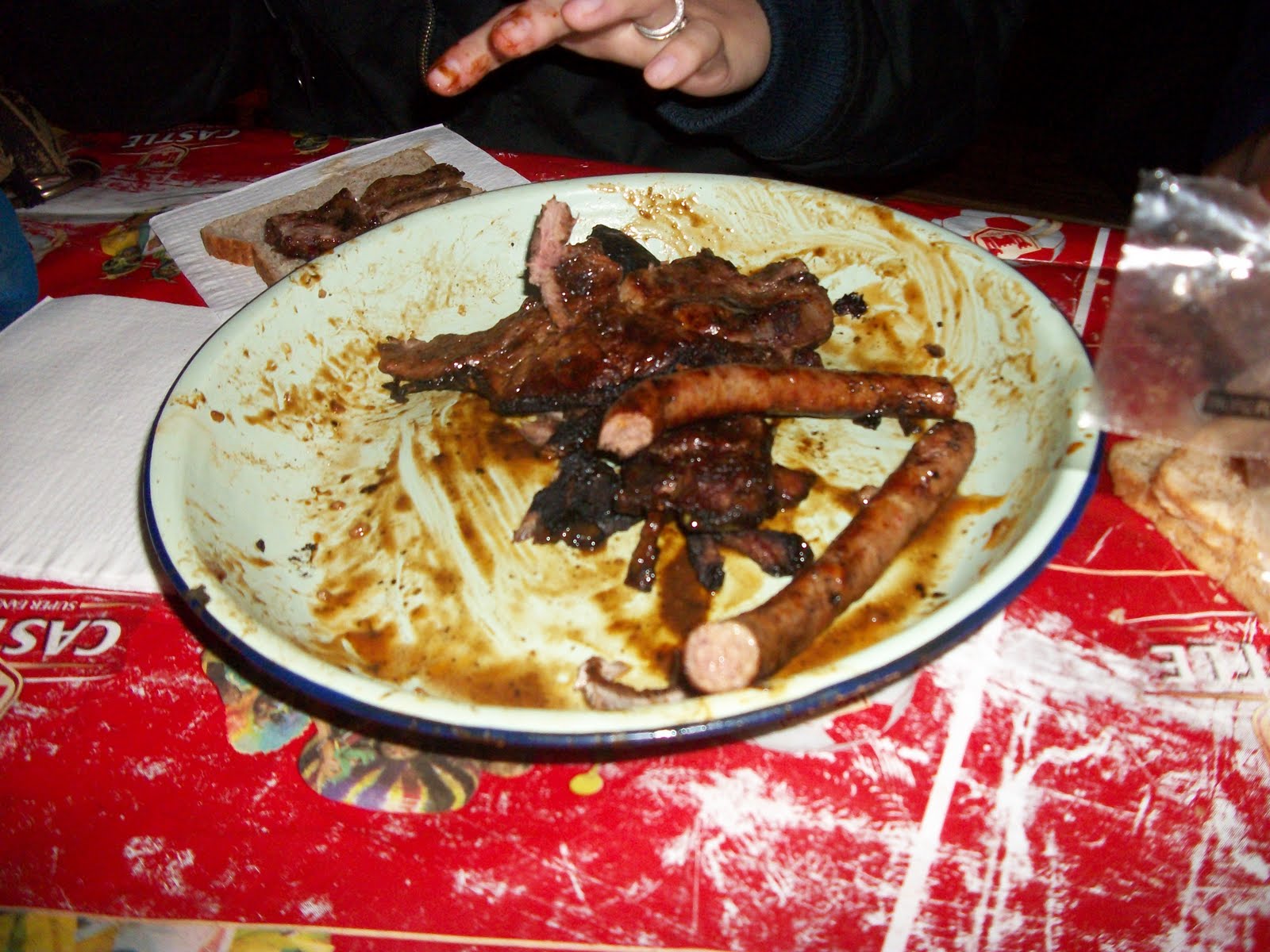
After the gun, we decided that we would head to the Township to eat at Mzoli's.  Mzoli's is a very famous Township meat restaurant in Gugulethu.  Despite the poverty of the Township, they love meat and will typically have a little meat with every meal.  At Mzoli's, you pick out the raw meat that you want from things like lamb, sausage, and beef.  They cook it up in a smokey room and bring the cooked meat out to you.  You typically buy a loaf of bread and wrap up pieces of the meat in the slices of bread.

After eating at Mzoli's, they wanted to show me some of the area.  They took me by the field and gym that they train at for the team.  They then took me to the home of the Captain of their team.  Most of the people in the townships live in tiny shacks that are constructed mainly of tin and he was no exception.  We hung out in the road as chickens wandered around.  The group of us just stood around and shot the breeze.  We spent a couple of hours not particularly doing anything.  Standing there, I got a feel for life of the township.  It was funny talking with the guys and them talking about how they didn't have time to do things like going to Church.  Most of the people don't have a car or a whole lot to do with their free time.  That is why something like TNHF is so important, because it gives the youth something to do with their time and a way out of poverty.  TNHF is also turning its focus more towards women as they are finding that oftentimes women are more responsible with their money than the men.

Being in the townships, you understand the enormity of the problem.  As I was leaving Cape Town, I drove by Khayelitsha -- the largest township in Cape Town.  From the main highway, I could see tin room shacks as far as the eye can see.  It's like gazing as the stars in the sky and feeling overwhelmed by the need that is out there.  I know that the small part that organizations like TNHF are doing is making a big difference in individual lives, but I felt for the all people that fall through the ginormous cracks.  http://www.thesenumbers.org/

Monday, July 26, 2010

My best day

The best day on my trip was my day of sightseeing around Cape Town.  I got up early and started out in Muizenberg.  I took some pictures of the city against the mountains and the coast -- beautiful.  I headed South to Boulders Beach to see the penguins!  That's right, penguins!  African penguins!  One of the coolest things I have ever done!  They have wooden boardwalks that you can walk out and get within a few feet of the penguins.  You come out to Foxy Beach and there are globs of them just chillin' on the beach.  Boulders Beach is next to Foxy Beach and is the beach that you can actually swim with the penguins.  Granted most of them hang at Foxy, but one brave soul wandered over to Boulders when I was there.

Driving further South, you head towards Cape Point and the Cape of Good Hope.  Contrary to popular belief, neither one of these capes are where the two oceans meet; that is actually Cape Aquinas -- a few hours west of Cape Town.  Cape Point has an old elevated lighthouse that you can hike up to.  When I was there, it was a beautiful sunny day and I had breathtaking views all around -- of the oceans, of the peninsula I had driven up, and of the lighthouse.  I just took and took pictures.  The Cape of Good Hope is actually only a couple of miles down the beach and is the Southwestern most point of Africa.  I went there, took my picture with the sign, and had a few Ostrich crossings.

Outside of the park, there is another market.  You feel kind of sleazy at the markets although you can get way better prices than the shops.  99% of all shopping experiences go so something like this:

Vendor:  "Hello my friend"
You: "Hi"
Vendor: "Your Welcome"
(Your eyes look at an item for three seconds and vendor sweeps in like a vulture)
Vendor "You like?  I give you good price"
You: "How much?"
Vendor: "Normally 150 Rand, but for you 120"
(You decide you aren't interested and try to walk away"
Vendor: "This isn't a store, How much you want to pay?  You tell me how much you want to pay"

Moving on from the market, I drove along the Coast.  The sun was beginning to go down, so I stopped every five minutes to take an even better photo of the coastline.  I eventually reached the world famous Chapman Peak Drive.  It costs about five U.S. dollars to go on and it's worth every penny!  This drive is built on the side of a cliff face (it is periodically shut down to falling rocks);  I was halfway expecting 007 to come racing around the corner while I was there.  I took some incredible photos here of Houk's Bay that could have been postcards -- wow!  I drove further and caught some people having wine as the sun was going down.  I continued on past kids playing soccer and eventually made my way to Cape Town.  I took some pictures of the Stadium and then my found my way to the beach.  I took some stunning sunset pictures as a sailboat sailed on by.

I then finished my day by heading to the top of a famous neighborhood of painted houses -- called Bo Kaap.  At the top of the hill, I ate dinner at a Malay restaurant called "The High Noon Tea Room".  Malay is a traditional fare that does not serve alcohol.  There was only one other couple in the restaurant so I grabbed a seat outside with the most incredible view of Table Mountain (the mountain overlooking Cape Town).  I ate a meal of traditional fish with some sort of Rose milk drink that was similar to a milkshake -- outstanding!  An absolutely wonderful way to finish a most stunning day.

Youth With a Mission (YWAM)

The road from Johannesburg to Cape Town is not the most exciting road in the World.  It is similar to the terrain in Eastern Washington.  Driving the route, you get a lot of time to think.  Not to mention that almost every speed sign has a camera on it to enforce speeding.  Most of the route is two lanes and there are hundreds of trucks going 80 km / hr and I nicknamed it "The Great Truck Weave".  As you approach Cape Town, you pass through a town called De Dooms which is an absolutely beautiful mountain pass.  The startling thing is that much of the town is tin roof shacks beneath majestic peaks.  This is the great contrast of South Africa -- rich and poor; luxury and barely enough.

Coming into Cape Town, I drove the Alternate Route winding around the mountain.  I had just missed the sunset, but I could still see the stunning view of the city of Pearl beneath me.  Later on I arrived in Muizenberg, a suburb on the coast a half an hour South of Cape Town.  I arrived to meet my hosts Bryan and Thandi Whitlock.  Thandi was eight and a half months pregnant, but she still had a delicious meal ready for me. 

Bryan and Thandi are on staff with an organization called Youth With a Mission (YWAM).  I had arrived just in time for the Netherlands / Uruguay match so Bryan and I headed over to the YWAM base to watch the match.  YWAM is an organization that works in just about every country and trains young Christian leaders from around the World.  I met some guys from Kenya, Madagascar, and Brazil.  YWAM actually has many different unique programs depending on the base.  However, typically trainees come to a base to attend a Discipleship Training School (DTS) for three months and then go out to do a mission for three months in another country. 

The next day Bryan and I headed into the city to watch the Germany / Spain match.  We got a chance to talk about his passion for ministry in Africa.  He had these little wafers with verses on them; everywhere we went, he passed them out to strangers and just kind of chatted with them briefly.  He didn't preach at them, but would just kind of say "It's food.  You can eat it".  When the person started asking questions about it, he might say something like "It's Spiritual food".  He was a man at ease -- a man who was right where he should be.  We went around the market.  While I was trying to negotiate for some souvenirs, he would strike up a conversation with the vendor.  None of the vendors are from South Africa so he would ask them where they were from and get in a conversation with him.  One of the vendors was from Sudan which he has a particular passion for and a place he has ministered.  Bryan and his wife want to go to the Sudan in a few years to be full-time missionaries.  I bought some things from the guy and Bryan took some pictures with me and the vendors.

YWAM is one of those things I seem to encounter wherever I go -- I'm always meeting people who have done it.  A few days later, I was in the Drakensburg Mountains and happened to get invited to a dinner at another YWAM base.  There I chatted with a Kenyan guy who had the best English of any Kenyan I have ever met.  He had spent some time in Iowa.  It was interesting talking to him and having him tell me that he had a passion for the people of the United States.  That's the Global nature of YWAM.  The people I have known associated with YWAM are some of the most authentic Christians I know -- so there must be something to this thing.  http://ywam.org/

Sunday, July 25, 2010

The kindness of strangers

I think most of us like to think that we are enlightened folks that are above the prejudices of ordinary people -- oh you know, other people.  Sometimes it takes an event to tear this illusion apart.

I needed a place to spend the night in Bloemfontein.  I could either seek out a hostel or try out coach surfing; Couch surfing is the idea of staying in the home of a perfect stranger.  I looked into it and found a couple of possibilities.  I contacted one and he wasn't going to be around.  That left a Muslim guy who had a couple of good reviews, but also had a profile that celebrated trips to Pakistan and Afghanistan.  This of course immediately brought to my mind Islamic fundamentalists and their not so fond view of Americans.  What to do...

I agonized over the decision and put it off.  As the World Cup went on, he got more and more great reviews.  It was reassuring to see a review of an Israeli holding a Jewish flag.  Embarrassed by my blatant stereotype, I realized I needed to trust in his hospitality.

And you know what, it went really well!  I arrived late around 10:30 pm, but yet he and the owner of the house (he rented from her) stayed up and had tea with me.  The next morning they both got up early and prepared a breakfast for me before I headed out.  They told me about places to stop on my long drive to Cape Town.  They were both so hospitable to me and I stood humbled in my bigotry -- no longer enlightened.

PDA Syndrome

This is none other than Put Down the African Syndrome.  It is a self inflicted syndrome that affects the Africans here.

I was talking with my hosts in Malawi and the girlfriend of one said that the Africans treat white people like gods (to which I replied, "well...yeah").  Her point being that there is a lack of confidence in their own abilities.  There is a huge problem holding onto money as many spend it as soon as they get it.  They go spend it on beer or cigarettes or other things like that.  There are a disproportionate number of Indian, Asian, and white run businesses in Malawi.  Most businesses have the owner on site of all times so that they can watch the Malawians who work here.

In South African, there is a huge fear of Xenophobia where the blacks are worried about Malawians, Zimbabweans, Zambians, etc. taking their jobs.  They will even speak to blacks in Zulu and arrest those who doesn't understand.  There is a huge fear right now that other African countries will use the World Cup as easy entry into the country and won't leave.

These are serious issues that  must be overcome for these countries to develop.  Training and education must take place for local run businesses and skilled labor to take off.  These are the type of things needed for serious economic development.  So how to do it?  I wish I knew.

Friday, July 23, 2010

The price of water and sanitation

The McGills in 2008
Perhaps my most eagerly anticipated trip was to see the shallow wells in Mzuzu, Malawi.  I made the long journey north chatting with a lovely missionary from Northern Ireland.  I spent my brief time in Mzuzu with Jim and Jodi McGill.  They are such hospitable and wonderful people.  They have adopted six children and have an Intern staying with them for the Summer, but they still welcomed me with open arms.

Jim works for the Presbyterian Synod (Livingstonia) and is responsible for water and sanitation for all of Northern Malawi.  He partners with organizations like Marion Medical Mission (http://marionmedical.org/) and Water For People -- Malawi http://www.waterforpeople.org/programs/africa/malawi.html) to install wells and eco-latrines. 

An inefficient Play Pump
The preferred shallow well
There is much to learn on the difficulties of effective development work.  For instance, a past organization called Play Pumps installed these play areas where children could play and pump water at the same time.  However, it was found that the pumps were inefficient and that they were overused by the residents.  The preferred well is something called a shallow well that is under 20 feet in depth.  Marion Medical is remarkably efficient at raising money for shallow wells.  For $350, a donor can build a well and get a picture of it.  However, the business of non-profits demands progress and so the target number of wells has been raised from 1,000 a year to 1,200 a year.  Great!  But oh wait, that target outpaces the ability of Jim and his team to effectively determine where the wells need to be.  It is harder to raise money when you don't have pictures.

The self drilled well
The hole they often drink out of
And then there's getting people to use them.  Marion considers that anyone within 500 meters of the well has access.  We drove to a site where there is a well that is within 500 meters of a group of houses.  But they don't use it!  They've dug their own well that is unsealed and often dries up.  When it is dry, they get their water from this hole.  We asked one of the guys why don't they use it.  The first reason that it was too far away and the second was that they didn't contribute to building it.  Marion asks for around 1500 Kwacha a year to maintain the well which is not that much -- even here.  It is equivalent to around 20 minutes of talk time on a phone or 8 beers at the bar.  Ah priorities!

Jim's team is working a new model where the residents would take ownership of the well.  Jim asked this guy if this group of 4 or 5 houses would be willing to take out a 50,000 Kwacha loan over two years through a micro finance organization like Opportunity International.  The guy sounded very open to it...open to the idea of ownership.

Finally, I wanted to mention another cool thing that Jim's team is doing.  They are working with Water For People to install eco-latrines.  These are latrines where people cover their manure with ash and soil.  in 6-12 months, the manure bio degrades into compost that be used for crops or sold for money.

Children of the Nations

One of the reason I wanted to come to Malawi was because I had connections through both Seattle and Atlanta.  One of these connections was Children of the Nations (COTN) where several of my friends had spent a Summer with COTN (http://www.cotni.org/).

Down goes Goliath!!
On my first full day in Malawi, I was picked up by Chris Adare.  I would later learn that Chris had graduated from U-Dub and even went to high school in Spokane with some of my friends.  He took me to go see what COTN was all about.  I visited one of the villages with a team from Colorado.  We play acted David and Goliath for the 1st grade class; I was the King.  At the break, we tossed miniature frisbees with the kids who derived such pleasure from such a simple game!

AWP Windmill
I later went around with Chris, who showed me the African Windmills Project (AWP).  They are in the process of perfecting a well driven by windmills that could be used for irrigation.  The one pictured here is missing the windmill, but can be hand cranked very easily.  The goal of the wells is to be constructed and maintained by locally found materials.  I journeyed with him to pick up wood from a Malawian lumber yard and to a welding shop as he worked on building another well.

Boiling some water!
I tried to ask Chris a lot of questions and also wanted to find out what COTN is doing about drinking water.  One thing he showed me was a solar heating system for boiling water.  The one here can boil water in an hour and forty-five minutes.  Chris is working on doing it in under an hour so that it will be more practical.

I finished up the day by visiting another village with the team.  We were welcomed by song and dance from the widows.  COTN has trained the widows with skills like crafts and baking and they have crafts available for purchase.  Afterwards, it was time to feed the children and we were welcomed by a song from them.  The children eat two meals a day -- one before school and one after school.  We helped them wash their hands and we dished their food.  We also had a Dentist and a Nurse in our group and we had an impromptu medical session where far more kids lined up for help than there was time for.

As for Chris, he got some unexpected time with my host Linga.  As we were wrapping up the day, we realized we could still catch the second half of one of the games.  The three of us went to the Four Seasons to unwind with some Carlsburg (there's a local plant).  Linga peppered him with questions about where he lived and what he was doing in Malawi.  It turns out the following day that we had to go pick up a credit card I lost from Chris.  We met him a local place far out of town where the power was out.  We sat on a porch under the stars and once again moved at the African pace.